Hi
@FrankB,
first of all, thank you very much for all the work you’ve done on this topic. As one of those … Mac users … my main interest isn’t so much the TripManager itself, but rather the wealth of information and documentation you’ve provided about trip files and their internal structure.
Since I’m not a fan of running Windows applications in a virtual machine on my Mac, and because I’ve made surprisingly good progress using “vibe coding” for my various stupid ideas, I went down that rabbit hole and started building a macOS app that aims to do something similar to TripManager.
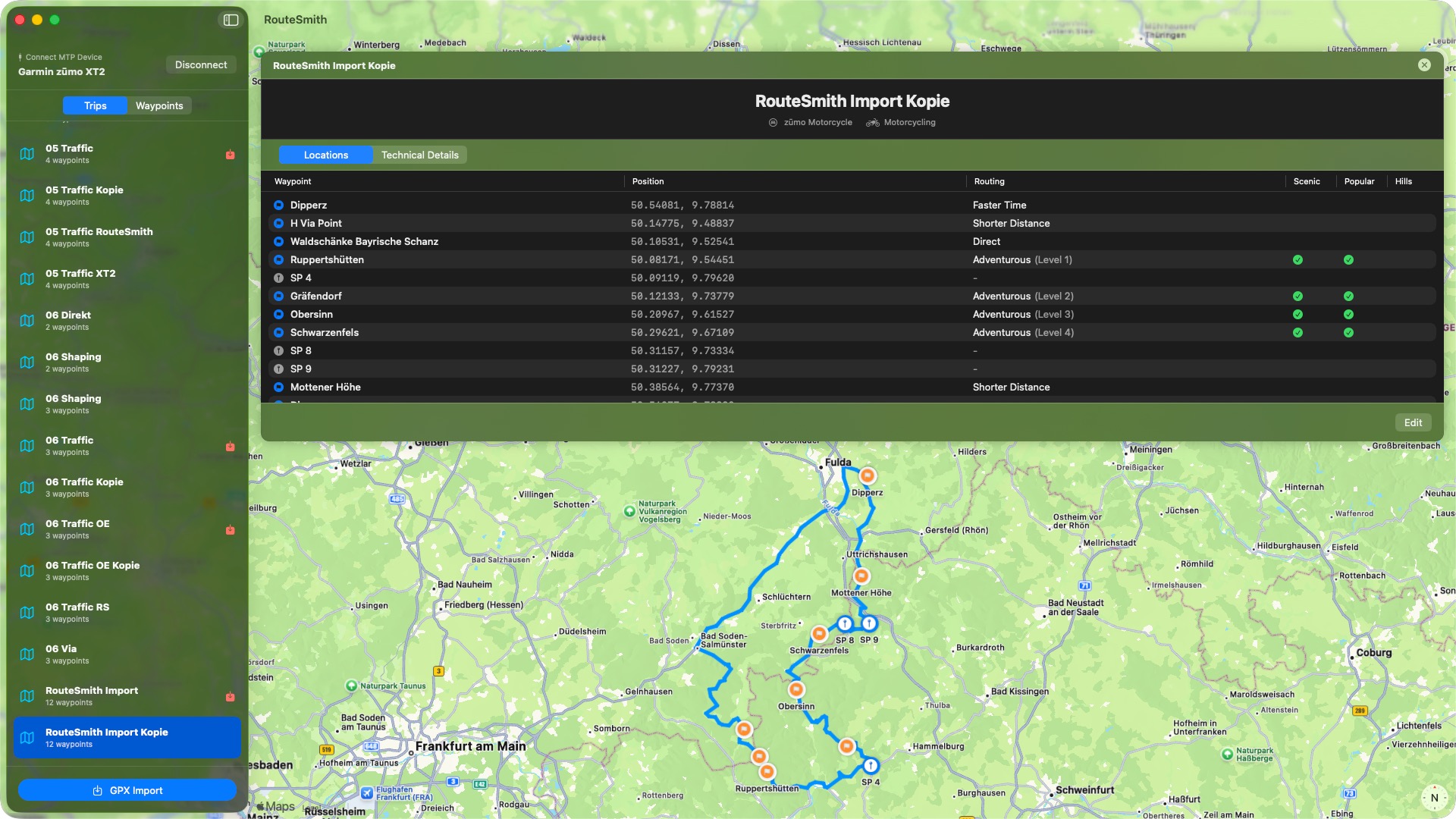
My main goal is to get routes planned in Kurviger onto a Zumo XT2 as accurately as possible. And yes — I’m chasing the unicorn here. Not only do I want the route to be 100% identical to what was planned in Kurviger, but I also want to retain device features like skipping waypoints or detouring by road.
Regarding the “100% like Kurviger” part, I was quite successful by exporting routes with the route point extension and importing them directly onto the device. However, the adventurous level was not set correctly after import — and at that time, I hadn’t even heard about the RUT issue yet.
That eventually led me to your tool and documentation — and finally to my actual question.
I tried to combine importing a route with the route point extension and modifying the trip file in a single step during import. I read all available information from the GPX file, including the CalculationMode and AdventurousLevel, and transferred that data into the trip file. The route containing the route point extension was “injected” into Current.gpx.
Unfortunately, this doesn’t work as expected. My hope was that the XT2 would generate the required subclass nodes when the route is opened for the first time after import — but it doesn’t. Instead, it actually wipes the route from Current.gpx.
Am I missing something here? Is there anything I can do to make this approach work?
Thanks again, and best regards
